
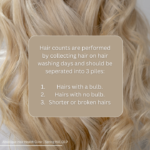
Hair count for hair loss is helpful to measure and track if hair loss is normal or abnormal. Daily normal hair loss is 70-160 diffusely over the scalp.
Collect hair on wash days
It is easier to collect hairs on hair washing days, as that is the time you generally will see more hairs. Hair washing does not cause hair loss. The manipulation of hair on hair wash day simply allows the hair that has already fallen from the scalp to be collected as you detangle and condition the hair.
Collecting and counting
Use a clean brush to detangle the hair, do hair washing routine then dry and style hair as usual. Collect all of these hairs. Put them in a pile so you can start counting.
Separate hairs into piles
The piles should be:
- Hair with bulb
- Hair with no bulb
- Shorter or broken hairs
Hair with bulb indicates it hair come from the scalp. Hair with no bulb can indicate there is a hair structure problem or loose anagen syndrome. Shorter or broken hairs, hairs with slits ends are a different type of hair loss – hair breakage.
Telogen effluvium hair loss
Telogen effluvium diffuse hair loss is the most common type of hair loss related to the hair cycle disturbance. You never go bald from this type of hair loss.
Telogen effluvium hair loss occurs three months after the cause. Hair will fall for three months and should stop. If the hair loss does not stop, it is super important to find the cause of hair loss. Hair loss is a sign something is wrong within the body – don’t ignore the signs.
Normal vs abnormal hair loss – telogen effluvium
Frequency of washing will determine amount of hairs collected.
- Normal 70-160 daily = 140-320 every second day
- 280 – 640 every 3rd day
- 560 – 1280 every 4th day
This is normal daily hair loss. Double this for current abnormal hair loss telogen effluvium.
Hair count for hair loss
The hair count for hair loss is to determine status of telogen effluvium. The hair count for hair loss is not suitable to diagnosis other types of hair loss such as:
- Pattern hair thinning which is not physical hair loss
- Alopecia areata
- Frontal fibrosing alopecia
- Ophiasis alopecia
- Other types of autoimmune hair loss
Count and record hairs
Separate, count and record your piles of hair. Store in envelope or bag, mark with date of hair wash, how many of the different piles of hairs – bulbs, no bulbs, broken, how many days since last wash – this is important *
Report to Trichologist
Repeat each wash to get your average hair count. Report back to your trichologist for more direction. Absolique Hair Health Clinic Trichologist – email ua.mo1792748598c.euq1792748598ilosb1792748598a@ofn1792748598i1792748598
Check out how we have helped so many with hair loss treatments, hair thinning treatment, hair growth treatment and scalp treatment